Other
Building a Mobile Proxy Business on the Side of Your OFM Agency: The Full Economics, the Real Grind, and What the Numbers Actually Say
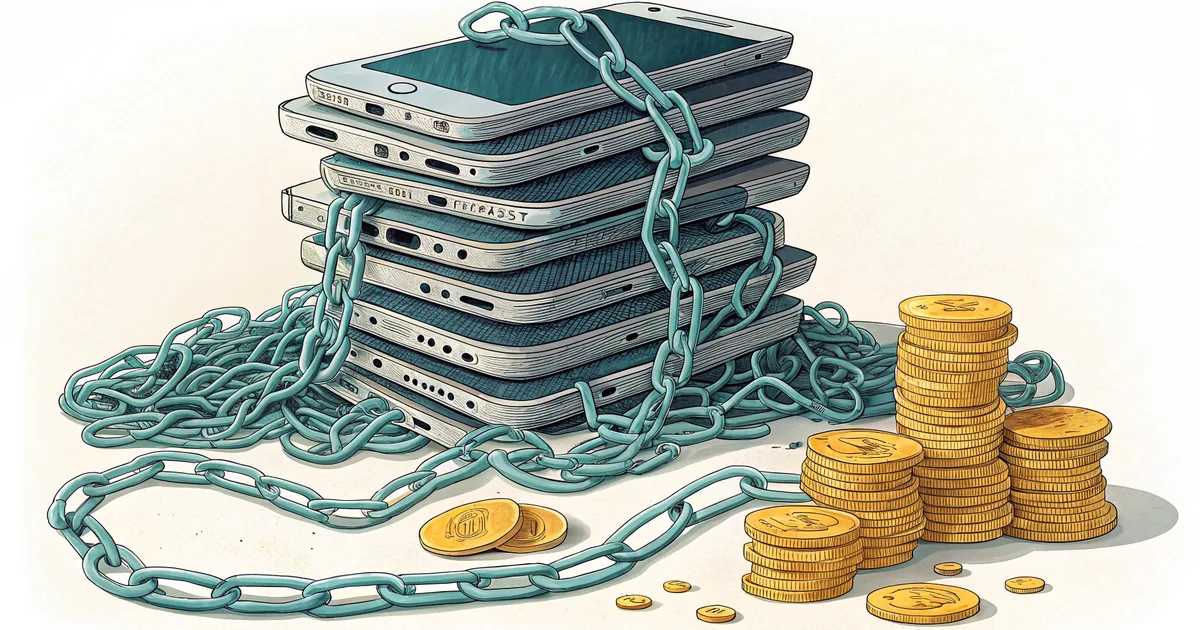
The pitch is seductive — passive recurring revenue from a rack of cheap phones. The reality is battery explosions, concrete walls killing your speeds, and a T-Mobile rep who wants six months of your payment history before he gives you another fifty lines.
Updated Jun 2026 · sourced from 17 YouTube creators and 7 operator groups
Key takeaways
- Postpaid business accounts beat prepaid on cost and carrier tolerance for 200 GB/month usage.
- T-Mobile at ~$20/line is achievable — but only after you've proven yourself as a customer.
- Samsung S8 bulk buys look cheap until 75% of them swell and split their cases.
- Concrete buildings can crater proxy speeds from 20 MB/s to 1 MB/s — location is everything.
- Proxy customers stack lines and churn slowly; the revenue is real but so is the daily operational drag.
Someone in the OFM space spent $1,600 getting a banned account reinstated. It was re-banned 48 hours later.
That's the industry these proxies serve — a market that is desperate for clean, rotating US mobile IPs, and not particularly price-sensitive when the alternative is losing a monetized account.
That desperation is the business case. The question is whether building the supply side is actually worth your time, or whether it quietly cannibalizes the agency work that pays better.
Let's go through this honestly.
The iProxy Model: What You're Actually Selling
iProxy.online lets you turn a smartphone and a SIM card into a sellable mobile proxy endpoint, and they explicitly pitch a reseller business model around it. (Yalla Papi, May 2026) The platform is well-known in the OFM community at this point — it's not a secret edge anymore, which matters when you're thinking about margin.
What you're selling is a rotating US mobile IP that resets via airplane mode. (faceless francis ofm, Feb 2026) The buyer gets something that behaves like a real consumer device on a real carrier network — because it is one.
That's why mobile proxies command a premium over datacenter IPs, which operators across multiple groups (late 2025 through mid-2026) describe as high-risk and easily flagged, with account freezes a common outcome when switching.
Postpaid vs. Prepaid: This Is Not a Close Call
Postpaid business plans are cheaper per line and carriers tolerate the heavy usage — think 200 GB per line per month — that a proxy farm generates. (Yalla Papi, May 2026) Prepaid is more expensive and less flexible at that consumption level.
Full stop.
The other underrated advantage: business telecom accounts bill in arrears. (Yalla Papi, May 2026) You pay at month-end for the prior month's service, and carriers extend more grace on late payment than consumer plans, which can cut service within a week.
For a side business with lumpy revenue, that cash-flow buffer is genuinely useful.
Negotiating T-Mobile Down to $20/Line
The ceiling most people hit is paying retail. The floor is achievable if you approach this correctly.
One documented approach: walk into a T-Mobile store, position yourself as a switching customer frustrated with your current carrier, and ask for 50 new lines without porting existing ones. (Yalla Papi, May 2026) The speaker secured 50 lines at roughly $20 each this way.
Here's the catch that nobody mentions in the pitch decks:
Carriers want to see a track record before they'll expand your account. (Yalla Papi, May 2026) T-Mobile's business rep asked for payment history, an EIN, and articles of incorporation before approving a second batch of 50 lines.
Plan to wait several months between scaling requests — not weeks.
Hit your direct carrier ceiling? One operator sourced an additional 50–100 AT&T SIM cards through a Reddit wholesaler after maxing out at 100 T-Mobile lines. (Yalla Papi, May 2026)
Third-party SIM resellers exist and can operate under a reseller umbrella; Reddit DMs are apparently a legitimate sourcing channel for this.
Handset Sourcing: The $30 Phone That Costs You More Later
Bulk wholesale is the only logical entry point for hardware. Around 100 Samsung S8 units with cosmetically damaged screens — black spots, cracked cases — can run roughly $3,000, or about $30 per phone. (Yalla Papi, May 2026)
The cosmetic damage doesn't affect proxy functionality, so the discount is real.
But the S8 has a known operational problem at scale: running plugged in 24/7 in a warm environment causes battery expansion in approximately 75% of units, eventually splitting the cases. (Yalla Papi, May 2026) That's not a minor inconvenience — it's a replacement cycle baked into your unit economics.
The recommendation from the same source is to use the cheapest available 5G-capable Android as your minimum spec. (Yalla Papi, May 2026) The 5G premium matters: newer, better-signal devices produce faster, more stable proxy speeds, and speed is what your customers are actually paying for.
One operator group (early 2026) reported a 20-phone farm generating over $150K, with phones costing roughly $100 each and lasting years — battery replacement when bloated rather than full device replacement. That's a single data point from one group, and the $150K figure is unverified chatter, not an audited number.
Take it as a ceiling illustration, not a projection.
The Location Problem Nobody Talks About Loudly Enough
This one can quietly wreck your business.
Concrete construction — common in Miami and hurricane-prone coastal markets — degrades cellular signal severely inside buildings. Proxy speeds drop from a healthy 15–20 MB/s down to roughly 1 MB/s. (Yalla Papi, May 2026)
That's not a minor dip. That's the difference between a product people keep and a product people ask for refunds on.
The Miami operator investigated roof antennas and alternative apartments and found no viable fix. (Yalla Papi, May 2026) Wood-frame construction markets — Texas is the cited example — offer far better signal penetration.
The counterintuitive finding: even at 1 MB/s, almost no customers actually cancelled. (Yalla Papi, May 2026) Responsive customer service mattered more than raw speed.
But don't let that result make you complacent about location — you'd rather not be in the hole to begin with.
Where Operators Disagree: The Hardware & Protocol Debate
This is where the evidence fractures, and you should know it.
On device quality and pricing: One operator group (early 2026) suggests phones at ~$100 each lasting years with simple battery swaps. The vetted source suggests starting closer to $30/unit on cosmetically damaged S8s but then upgrades that recommendation to 5G-capable devices due to battery failure rates. (Yalla Papi, May 2026) (Yalla Papi, May 2026)
These aren't incompatible, but they point to different hardware strategies — cheap-and-replace versus slightly-more-expensive-and-maintain.
On proxy protocol: Operator chatter from late 2025 splits between preferring SOCKS5 for phone-based apps and HTTP for web interfaces — with at least one report that switching from SOCKS to HTTP (same provider) fixed a bot send failure. Multiple groups agree on mobile over datacenter, but the specific protocol recommendation varies by use case.
Neither side is clearly wrong; they're solving different problems.
On scale economics: The $150K figure from one operator group (early 2026) is a single, anonymous, unverified claim. It corroborates the general 'this business is viable' thesis but shouldn't anchor your projections.
The Customer Math: Why Retention Matters More Than Acquisition
Proxy buyers behave differently from most SaaS customers. They come back the next day to add lines. (Yalla Papi, May 2026)
Buyers regularly retain 5–6 lines for extended periods, making each acquired customer disproportionately valuable.
The implication for your go-to-market: invest more in the first conversion than you'd expect. A customer who buys one line and has a good experience is likely to double or triple their spend within a week.
That retention profile is genuinely attractive. It also means a bad customer experience — slow speeds, unresponsive resets, hardware failures — doesn't just cost you one line.
It costs you the 5-line account they would have become.
The Operational Reality: Daily Resets Are a Job
Here's the part of the pitch that gets soft-pedaled.
At any real scale, you will receive a constant stream of messages requesting resets, handling cancellations, and troubleshooting hardware. (Yalla Papi, May 2026) The operator who documented this explicitly said it consumed time better spent on the higher-margin agency work.
That's the fundamental tension of this side business. It's recurring revenue, but it's attended recurring revenue.
It does not run itself.
The operational load scales roughly linearly with your line count. At 50 lines, maybe manageable solo.
At 150+ lines, you're looking at a part-time hire or a very structured async system for handling reset requests.
Factor this honestly before you order 100 phones.
Scaling the SIM Supply When Carriers Cap You
T-Mobile will cap you. (Yalla Papi, May 2026) It's a when, not an if.
The documented ceiling for a direct T-Mobile business account was 100 lines before the rep started requiring additional justification and wait time.
Your two-track approach when that happens:
- Reddit wholesale: Post in the relevant subreddits, DM wholesalers who can supply business-grade unlimited-data SIMs under a reseller umbrella. (Yalla Papi, May 2026) This is how the 50–100 AT&T SIM extension was sourced.
- Multi-carrier diversification: Don't be 100% T-Mobile. Carrier-diversified inventory also gives you a hedge against any single carrier changing its policy on business account data usage.
What This Actually Costs to Start
Pulling from the vetted numbers only:
- Handsets: ~$30/unit for cosmetically damaged Samsung S8 bulk. Budget higher (~$100/unit) if you're going 5G-capable from day one.
- Carrier lines: Target ~$20/line/month on a postpaid business negotiation.
- At 50 lines: Roughly $1,000/month in carrier costs. Hardware at $30/unit = $1,500 up front for the devices.
- iProxy platform fees: Not disclosed in the vetted evidence — check their current reseller pricing directly before modeling margin.
The revenue side depends entirely on what you charge per line and your churn rate. With multi-line retention being strong (Yalla Papi, May 2026), the unit economics can work — but the numbers above are the only ones you should trust as a starting point.
The Honest Bottom Line
Mobile proxy reselling is a real business with real demand, genuine recurring revenue, and documented paths to scale. The iProxy reseller model is straightforward.
The T-Mobile negotiation is learnable. The wholesale handset sourcing is accessible.
But it is not passive, it is not location-agnostic, and it will absolutely steal time from your agency if you don't build a process for the daily operational load. (Yalla Papi, May 2026)
Run this as a deliberate second business with its own systems — not as an afterthought you manage from your phone between chatter shifts. If you're in a concrete building in a coastal city, solve the location problem before you order the SIMs. If you're in Texas with a wood-frame setup and T-Mobile coverage, your path to 50 lines at $20 each is genuinely achievable.
The battery explosions and the 1 MB/s speeds and the constant reset requests are real. So is the customer who buys one line and comes back the next morning for five more. (Yalla Papi, May 2026)
Both things are true. Build accordingly.
Sources
On the record (YouTube creators):
- Yalla Papi — The Glorious Rise And Fall Of My $100k Mobile Proxy Business, May 2026. Watch ↗
- faceless francis ofm — How a $1M/Month OnlyFans Management Agency Actually Works (Full Breakdown), Feb 2026. Watch ↗
Community intelligence: 31 operator claims aggregated from 7 separate private OFM groups (Dec 2025–Jun 2026), corroboration counted across groups. Group identities are withheld to protect sources; browse the underlying intel in the Community Intel Wiki.