Meta's Two-Element Test: Exactly What Triggers AI Enforcement on Instagram
It's not the bikini pic. It's not the link. It's both at once — and Meta's AI is trained to catch exactly that combination.
Updated Jun 2026 · sourced from 19 YouTube creators and 9 operator groups
Key takeaways
- Suggestive content alone or a link alone rarely bans you — the combination does.
- Sales language in bio ('45% off', 'DM me') is a solicitation signal, not just marketing.
- Over 95% of Meta's proactive detection is AI-run, with a confirmed 10–20% false-positive rate.
- Moving the OF link to Highlights or a custom domain reduces — but doesn't eliminate — exposure.
- Becoming a 'content creator first' is the only durable long-term strategy on Instagram.
An agency owner pays $1,600 to get a 70k-follower Instagram account unbanned. It comes back online.
Forty-eight hours later, banned again — same reason, same AI flag, same dead funnel. No refund.
That story circulates in operator chatter (multiple groups, early 2026). It's unverified.
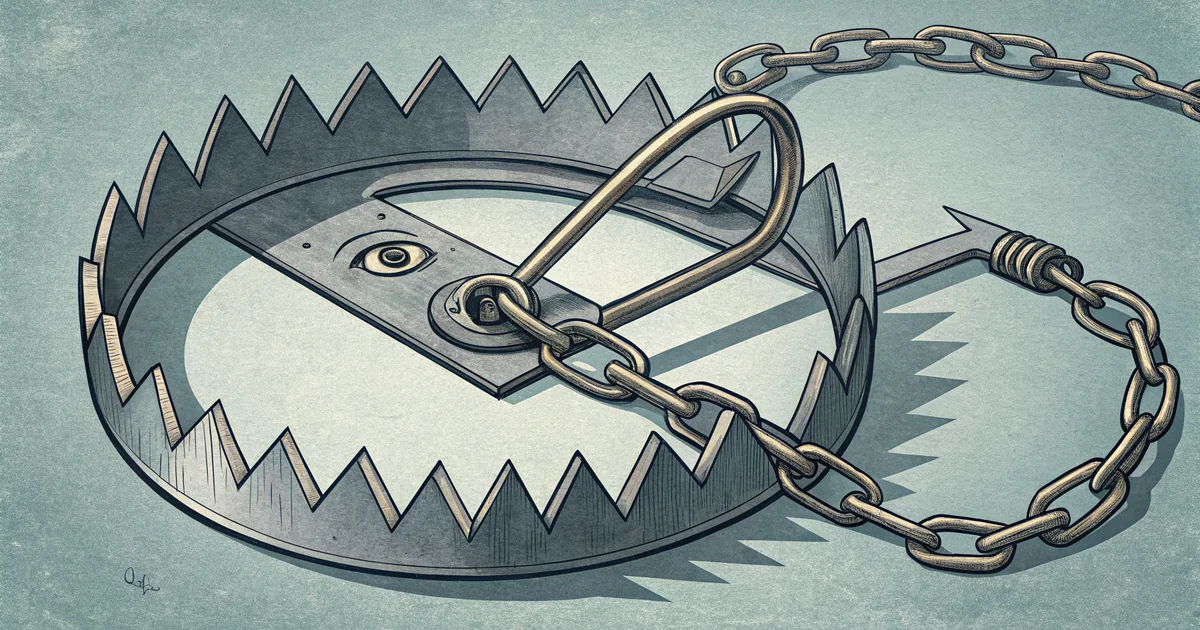
But it maps perfectly onto something that is verified: Meta has a two-element test, and if you don't understand both elements, you'll keep feeding accounts into the same grinder.
The Test, Plainly Stated
Meta's enforcement AI looks for two signals firing together: sexually suggestive content (poses, bare skin, suggestive emojis, adult-coded clothing) and solicitation indicators (external links, 'DM me' language, payment references, discount copy). (faceless francis ofm, Apr 2026)
Either element alone may be tolerated. The combination reliably triggers enforcement. (faceless francis ofm, Apr 2026)
This isn't a theory. It's on the record.
And it explains why accounts running lifestyle content with a plain bio survive while accounts with identical follower counts but a 'link in bio + thirst trap' setup get wiped.
Why the AI Catches It So Fast
Over 95% of Meta's proactive content detection is now run by AI, not humans. Meta's trust-and-safety operation employs more than 40,000 people — but is systematically replacing reviewers with automated systems. (faceless francis ofm, Apr 2026)
The confirmed false-positive rate is 10–20%. That means millions of innocent posts get flagged every day. (faceless francis ofm, Apr 2026)
If your content is borderline, that error rate is not your friend — it's a timer.
Meta's AI doesn't just read text. It scans visual frames, audio, poses, emoji combinations, caption tone, and the destination URL of any link it finds. (Patrick Mulroy, Jul 2025)
When it detects adult-space hashtags like 'OnlyFans', lingerie-adjacent imagery, or implied nudity alongside any outbound link or payment-adjacent copy, the flag fires. (Patrick Mulroy, Jul 2025)
Adam Mosseri has publicly confirmed Instagram bars solicitation. That's the actual line. (Will Mammone, May 2026)
Signal One: What Counts as 'Suggestive'
This is broader than most operators expect.
It's not just nipslips or explicit content. Instagram's AI is trained on bare skin, suggestive poses, and sexual caption undertones — and will flag borderline material even when it doesn't technically violate policy. (faceless francis ofm, Apr 2026)
Fully-clothed but suggestive posing now puts pages under review. (Patrick Mulroy, Jul 2025)
Operators across multiple groups (early–mid 2026) report shadowbans hitting 'girl next door' content with minimal skin and no explicit words. One group flagged accounts getting restricted despite no bio link and covered-up reels — enforcement is running broad.
The practical ceiling is clear: keep content as close to PG as possible in the current environment. (Luca Pritchard, Apr 2026) Accounts that push suggestiveness to the edge convert worse anyway — subscribers pay less for models who show everything publicly. (Luca Pritchard, Apr 2026)
Signal Two: What Counts as 'Solicitation'
This is where most operators make the mistake that costs them the account.
Solicitation isn't just an OF link in the bio. It's any language that reads like a sales funnel. 'DM me for details.' '45% off, next 10 people only.' 'Free now.' 'Link in bio.' (Will Mammone, May 2026)
That copy, sitting next to suggestive content, is the exact trigger Meta's two-element test is designed to catch. (faceless francis ofm, Apr 2026)
Automated DM platforms like ManyChat make it worse. The pattern they generate — outbound messages, response sequences, payment nudges — closely mimics romance-scammer solicitation flows that Meta is specifically targeting. (faceless francis ofm, Apr 2026)
The marginal conversion lift isn't worth the account-loss risk right now. (faceless francis ofm, Apr 2026)
Even 'scammer pattern' language in bios and captions — coercive copy, urgency hooks, payment references — activates the same detection. Scrub it. (faceless francis ofm, Apr 2026)
The Link Problem Is Messier Than You Think
Here's where the evidence gets genuinely complicated — and where you need both sides.
One position: The link itself isn't the trigger; the content context is. If links alone caused bans, every OF model on Instagram would be hit.
Remove the suggestive content, and the link becomes inert. This view is held by operators in at least two groups (early 2026).
The opposing position: Instagram shipped automated link-flagging to 100% of users (confirmed across at least three separate groups, early–mid 2026). This flagging is described as unpredictable and hit-or-miss — hitting custom domains, Linktree, Beacons, and link.me alike.
Separately, a standalone source notes that simply having a link in bio can suppress reach even when account status stays green, and that this is 'confirmed, not a myth' (one group, late 2025 to early 2026).
The practical read: both things can be true. The link probably doesn't trigger bans in isolation.
But when combined with suggestive content, it's the solicitation-signal half of the two-element test — and the automated flagging layer means it gets scrutinized regardless.
The link-tool landscape is its own minefield. Linktree, link.me, Beacons, and hoo.be have all been flagged by operators at various points (multiple groups, 2025–2026).
Several groups recommend custom domains to force individual evaluation rather than platform-wide crawling. (Gavin Magoon, May 2026) One vetted creator recommends self-hosting on a clean domain via Netlify with no adult keywords, for the same reason. (faceless francis ofm, Apr 2026)
Another recommends connecting custom domains directly to link providers rather than simple forwarding. (Gavin Magoon, May 2026)
Big names reportedly moved the OF link out of the bio entirely — operators in one group noted this around mid-2026, citing it as a signal of a policy shift.
One tactic with meaningful support: move the link to Highlights using an archived story post from weeks or months ago rather than keeping it live in the bio. (TDM Business (OFM), Jun 2026) This approach has been tested against custom domains, third-party link tools, and deep links — none work consistently. (TDM Business (OFM), Jun 2026)
How to Defuse Both Triggers Simultaneously
The goal is to avoid firing either signal, not just one.
On the content side: - Post lifestyle-heavy, non-overtly-sexual content. Think 'personal diary,' not OnlyFans promo. (B9 Agency, Dec 2025) - Never post bikinis, nipslips, or sexually suggestive imagery. (faceless francis ofm, Apr 2026) - Avoid adult-space hashtags, suggestive caption undertones, and sexual emoji combinations. (Patrick Mulroy, Jul 2025) - Use Trial Reels to test borderline content before committing it to the main feed. (Patrick Mulroy, Aug 2025) If it gets flagged, you haven't poisoned the primary account.
On the solicitation side: - Strip all discount language, urgency hooks, and 'DM me' copy from bio, captions, and DMs. (faceless francis ofm, Apr 2026) - Remove automated DM funnels entirely until the current enforcement cycle eases. (faceless francis ofm, Apr 2026) - Don't let the link stand alone in the bio next to no other social presence — that absence of context makes the violation cleaner in Meta's view. (Will Mammone, May 2026)
On the link side: - Move the OF link to Highlights, not the bio. (TDM Business (OFM), Jun 2026) - If using a bio link, run a custom domain on a clean, adult-keyword-free landing page. (faceless francis ofm, Apr 2026) - Keep landing page copy vanilla — 'exclusive content', no OF mention, no suggestive visuals. (Operator consensus, multiple groups, early–mid 2026.)
The Post-Viral Trap Nobody Warns You About
Here's a wrinkle that doesn't fit neatly into the two-element model but is too important to skip.
Instagram now appears to implement a post-viral review — once a reel starts gaining significant traction, accounts (especially more sexual ones) get flagged and restricted at the moment of breakout. (Oliver Smole, May 2026) This was observed across a majority of a 50-agency survey sample and is not officially confirmed by Meta. (Oliver Smole, May 2026)
Treat it as strong practitioner signal, not established fact.
The implication: even perfectly structured content can get caught once it starts performing. This is one more reason the 'content creator first' posture matters — accounts with clean, non-solicitation histories have more runway when the post-viral review fires.
Where Operators Actually Disagree
The evidence conflicts in two places worth naming directly:
Aged accounts: One group says aged US accounts last longer and are better for ads. Another says Instagram removed the aged-account option, making them hard to source.
A third says fresh accounts beat aged ones because old audiences misalign with model niches and kill engagement. No consensus.
If you're buying aged accounts, you're running an experiment, not following established practice.
Proxy vs. mobile data: Multiple groups say don't use proxies — regular mobile data is safer and more human-looking. Other operators run static residential proxies or 5G mobile proxies (T-Mobile US-geo) without issue.
At least one group says residential proxies work fine, mobile proxies also work but cost more. The honest answer: mobile data has the broadest support, but the proxy debate is genuinely unresolved.
The Only Durable Answer
Tactics will keep shifting. Every link-in-bio workaround has a shelf life.
Every 'safe' link tool eventually gets crawled.
The long-term strategy with the most vetted support is straightforward: become a content creator first. Build a genuine niche fan base around humor, education, entertainment, or personality.
Treat OnlyFans as a passive bio link, not an active sales pitch. Give Instagram no solicitation signal to find. (Will Mammone, May 2026)
When there's no second element, the two-element test can't fire.
The $1,600 unban story is a cautionary tale not because the fee is a scam (it may well be real — operator chatter from early 2026 puts unbans via real reps at $1,600–$1,700, with anything cheaper being resellers). It's a cautionary tale because the account came back into the same setup and got re-banned in 48 hours.
The infrastructure didn't change. The content didn't change.
The signals didn't change.
Meta's test doesn't care how much you paid. It cares whether both elements are present.
Remove one. Preferably both.
Sources
On the record (YouTube creators):
- faceless francis ofm — Instagram Is Cracking Down on OnlyFans Creators. Protect Your Pages., Apr 2026. Watch ↗
- Will Mammone — Never Get Your IG Banned Again (Onlyfans Marketing Guide), May 2026. Watch ↗
- B9 Agency — How We Got 200K Followers In 90 Days I OFM Instagram Guide, Dec 2025. Watch ↗
- TDM Business (OFM) — The Death of Social Media Marketing in OFM (Interest Media), Jun 2026. Watch ↗
- Luca Pritchard — Full Instagram Marketing Guide 2026 for OFM and OFSM Agencies (Just copy me), Apr 2026. Watch ↗
- Patrick Mulroy — OnlyFans Creators: 2026 Instagram Ban Survival Guide To INCREASE Your Traffic, Jul 2025. Watch ↗
- Oliver Smole — How OFM Agencies Avoid Instagram Bans in 2026, May 2026. Watch ↗
- Patrick Mulroy — OnlyFans Instagram Growth: 0 To 20k+ Followers In The Next 90 days (Full Strategy), Aug 2025. Watch ↗
- Gavin Magoon — Steal These OnlyFans Marketing Secrets (Protect Your Accounts & Scale Safely), May 2026. Watch ↗
Community intelligence: 164 operator claims aggregated from 9 separate private OFM groups (Dec 2025–Jun 2026), corroboration counted across groups. Group identities are withheld to protect sources; browse the underlying intel in the Community Intel Wiki.