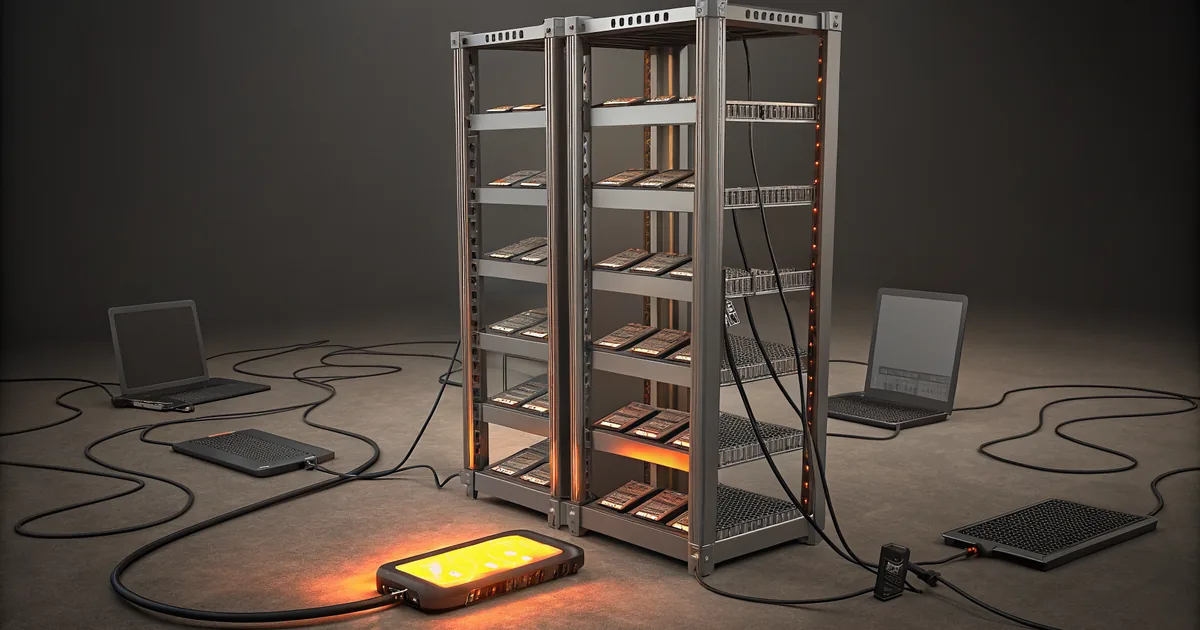
Other
Phone Farm Economics: Real Numbers, Real Costs, and the Technical Bar Most Operators Can't Clear
The numbers are real, the technical requirements are brutal, and the market is full of people selling you a charging rack and calling it a business.
Updated Jun 2026 · sourced from 14 YouTube creators and 9 operator groups
Key takeaways
- A 20-phone farm reportedly cleared $150k+; hardware runs ~$100/phone when sourced right.
- Most sold 'phone farms' are overpriced racks — the electronics are what you're actually buying.
- Real automation requires C/C++, Python, networking, and some3c control boards — not plug-and-play.
- iPhones carry a trust-score advantage for dating-app automation; battery bloat is the silent killer.
- Scale only justifies itself at hundreds of phones; below that, your time cost eats the margin.
Someone in this industry paid roughly $1,600 to get an account unbanned. It re-banned in 48 hours.
That same impulsive, cost-blind energy is how most operators approach phone farms — buy the rack, skip the research, wonder why it doesn't work.
Let's fix that.
The Number Everyone Quotes, and What It Actually Means
One operator, cited across chatter from early 2026, reported clearing $150k+ from a 20-phone farm. That figure gets repeated.
What gets ignored is everything underneath it.
The phones themselves? Roughly $100 each — a manageable $2,000 at that scale.
One creator sourced ~100 Samsung S8 units with cosmetically damaged screens for about $3,000 total, or ~$30 per phone, from wholesale resellers. (Yalla Papi, May 2026) Cosmetic defects don't affect proxy functionality, so cracked cases and black spots are irrelevant. (Yalla Papi, May 2026)
But hardware is the cheap part. The expensive part is invisible.
What You're Actually Buying (And What You're Not)
Operators in multiple groups, consistently through mid-2026, are blunt about this: most sold 'phone farms' are overpriced racks and chargers with no real electronics inside. The value isn't in the enclosure. A 100-port USB charger costs around $130 on Amazon — you don't need to pay a vendor $3,000 for the privilege of plugging phones in. [g9, 2026]
What you do need — and what most vendors won't hand you — is the control layer.
Real phone-farm automation at meaningful scale requires some3c.com control boards, plus genuine engineering chops: C/C++, Python, and networking fundamentals. [g9, 2026] This isn't a weekend project. This is a software engineering problem that happens to involve physical hardware.
If you can't write a Python script that handles device state management, you're not running a phone farm. You're babysitting a wall of smartphones.
The iProxy Model: Simpler, But Still Operational
iProxy.online has a more accessible entry point — it lets you spin up and resell mobile proxies from a smartphone and a SIM card. (Yalla Papi, May 2026) The pitch is straightforward, and US mobile proxies have genuine demand in the OFM ecosystem.
But even this simpler model has a hidden cost.
One operator who ran a proxy side business alongside an agency described constant reset requests, cancellation messages, and hardware troubleshooting eating time that was worth more on the agency side. (Yalla Papi, May 2026) Operational drag is real, and it scales with phone count.
The Carrier Scaling Problem Nobody Talks About
You want 100 lines. Carriers don't care what you want.
T-Mobile's business rep required demonstrated payment history before approving a second batch of 50 lines — and asked for business paperwork: EIN, articles of incorporation. (Yalla Papi, May 2026) Plan to wait several months between scaling requests and build the legal entity before you need it. (Yalla Papi, May 2026)
And where you physically put the farm matters as much as how you build it. Concrete-construction cities like Miami create severe cellular signal attenuation — one operator investigated roof antennas and alternative apartments and found no viable fix. Wood-frame construction markets like Texas offer meaningfully better signal penetration. (Yalla Papi, May 2026)
This isn't a minor variable. Dead signal kills throughput, and throughput is your product.
iPhone vs. Android: The Trust-Score Argument
This is where operator opinion splits, and both sides have logic behind them.
The case for iPhones: For dating-app automation specifically, iOS devices score the highest trust ratings. iPhone X, 11, or newer — avoid older models like the 6 or 7 to reduce bans. (habibi, Sep 2024) One operator community (single group, mid-2026) goes further, arguing iPhones are broadly preferred for phone farms because they're harder to automate — which counterintuitively makes them look more legitimate to platform detection systems. [g9, 2026] Platforms are increasingly shifting to overall account trust scores rather than per-action judgments, a trend already active on X with Meta reportedly heading the same direction. [g1, 2026]
The case for Android: Scale economics favor Android hard. The Samsung S8 fleet at $30/unit versus an iPhone 11 at multiples of that cost is a real difference at 100+ phones. (Yalla Papi, May 2026)
One operator found that a Samsung S21 — received by accident from eBay — had zero reliability issues compared to the S8 fleet, and its 5G connectivity offered both higher speeds and potentially better IP reputation. (Yalla Papi, May 2026) The recommendation from the same source: use the cheapest available 5G-capable Android as your minimum spec, not older 4G hardware. (Yalla Papi, May 2026)
Where they agree: Whatever you run, 5G capability matters. (Yalla Papi, May 2026) And whatever you run, battery bloat will eventually find you.
Battery Bloat: The Slow Disaster
Running Samsung S8 phones plugged in 24/7 in a warm environment causes battery expansion in approximately 75% of units, physically splitting the cases. (Yalla Papi, May 2026) This isn't a fringe failure mode — it's nearly universal at sustained operation.
One operator's practical rule: replace the battery when it bloats; don't wait for the case to split. [g2, early 2026] Higher-quality, newer handsets reduce the frequency — another point in favor of not buying the absolute cheapest hardware available. (Yalla Papi, May 2026)
A warm server room plus a wall of cheap phones plus 24/7 power draw is a thermal management problem. Plan for it before you build, not after your third case splits.
Where Operators Disagree: The Honest Breakdown
The evidence on several key questions is genuinely split. Here's what's contested:
Android cloning tools: AppCloner is reportedly mostly detected by platforms, with serious operators running private custom modules and kernel forks tested against services like Revolut for fingerprint integrity. [g4, 2026] But emulators are still reported working for certain automations as of 2026. [g3, 2026] There is no consensus on which approach holds longer.
Account aging vs. fresh warmup: One stream of chatter holds that fresh accounts last just as well as aged ones if the warmup is thorough and unhurried. [g3, 2025-12] Another argues that aged accounts — some operators specify 5+ years for Telegram — significantly reduce ban rates. [g3, 2026-05] Both positions have support from distinct groups. Neither is settled.
iPhones for Threads specifically: One creator runs multiple iPhones — X, 11, 12 Mini — each on separate pay-as-you-go SIMs with no VPNs, no proxies, no jailbreaking, and explicitly avoids Android for Threads. (habibi, Jan 2025) A separate operator community argues that for Threads scale you should skip proxies entirely to ensure USA-audience targeting and just replicate top posts across accounts. [g8, 2026-04] The hardware and proxy philosophy differs, but both agree on the multiple-accounts approach. (habibi, Jan 2025)
When scale justifies investment: This is the sharpest disagreement. One operator reports $150k+ from 20 phones — suggesting relatively modest scale can produce serious revenue. [g2, early 2026] Another operator community argues the real automation infrastructure (some3c boards, custom dev work) is only worthwhile at hundreds of phones. [g9, 2026] These aren't mutually exclusive — the $150k figure may reflect a specific use case and operator skill set that doesn't generalize — but the disagreement is real and worth sitting with before you commit capital.
The Dating App Decay: Context for Why Farms Exist
Phone farms grew out of dating app traffic. That market has largely collapsed.
One agency that previously invested tens to hundreds of thousands of dollars in phone farms, staff, and API bots for dating app traffic at scale concluded that Tinder and Bumble are no longer viable for OFM traffic generation — platform security kills accounts within minutes, and the user base is now desensitized to OF funnels. (TDM Business (OFM), Dec 2025) That assessment is corroborated by multiple groups through early-to-mid 2026: Tinder US has mandatory face verification that's effectively impossible to bypass at scale, conversion rates have collapsed (one group reports 1,000 adds yielding 5–20 subs versus ~80 a year ago), and mass ban waves have hit even recently registered accounts. [g3, 2026]
The phone farm pivot for many operators has shifted toward proxy resale — selling the mobile IP infrastructure itself — rather than running OF funnels through dating apps. That's a meaningfully different business with different economics.
The Real Technical Bar
Let's be explicit about what competency this actually requires:
- C/C++ for low-level control board interaction [g9, 2026]
- Python for automation scripting, device state management, and proxy logic [g9, 2026]
- Networking fundamentals — IP reputation, carrier-grade NAT, proxy rotation, signal attenuation [Y13, g9]
- Hardware management — thermal planning, battery replacement cycles, SIM provisioning [Y2, Y38]
- Carrier relationship management — business entity setup, payment history, incremental line expansion (Yalla Papi, May 2026)
This is not a skill set you acquire by watching YouTube videos for a weekend. It's a genuine technical operation.
The operators clearing real money from it are treating it as such.
The Bottom Line
The $150k-from-20-phones figure is real — but it's a ceiling for a specific operator in a specific setup, not a floor you can expect to hit by buying a rack and plugging in phones. [g2, early 2026]
The actual investment calculus:
- Hardware: $100/phone or less at wholesale, 5G-capable, newer models reduce battery failures [Y10, Y11]
- Control layer: some3c boards plus real dev work — not optional at serious scale [g9, 2026]
- Location: wood-frame construction, reliable cellular signal — Miami is a documented failure case (Yalla Papi, May 2026)
- Carrier scaling: months of lead time, business entity required, incremental approvals (Yalla Papi, May 2026)
- Operational drag: constant resets, cancellations, hardware issues — price this into your time (Yalla Papi, May 2026)
If you're a strong Python developer with networking experience and can wire up a some3c board, a phone farm is a legitimate infrastructure business with real demand. If you're buying someone else's 'turnkey farm,' check whether it has any electronics in it at all before you pay.
Most don't. [g9, 2026]
Scale justifies the investment. Fifty phones probably doesn't.
Several hundred might. The operators doing this profitably are engineers first, OFM operators second.
Everyone else is paying $30 per phone to charge a wall of bricks.
Sources
On the record (YouTube creators):
- TDM Business (OFM) — The Ultimate Social Media Tier List for OFM 2025, Dec 2025. Watch ↗
- Yalla Papi — The Glorious Rise And Fall Of My $100k Mobile Proxy Business, May 2026. Watch ↗
- habibi — Onlyfans THREADS Strategy OCT 2025**, Jan 2025. Watch ↗
- habibi — Onlyfans management Ask me anything (leaked call), Sep 2024. Watch ↗
Community intelligence: 198 operator claims aggregated from 9 separate private OFM groups (Dec 2025–Jun 2026), corroboration counted across groups. Group identities are withheld to protect sources; browse the underlying intel in the Community Intel Wiki.