Sales & Chatting
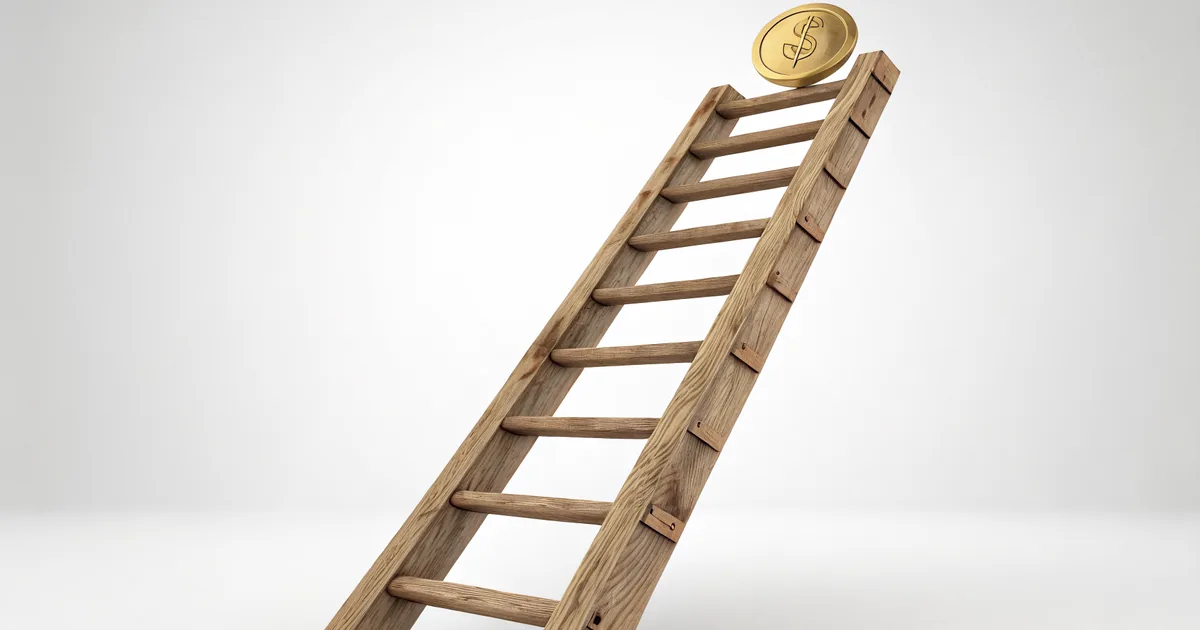
PPV Pricing Psychology: The $15→$35→$60→$100→$200 Ladder, When to Break It, and What the Numbers Actually Say
Everyone in OFM has a pricing ladder. Almost nobody knows when to abandon it — and that gap is costing accounts five figures a month.
Updated Jun 2026 · sourced from 17 YouTube creators and 7 operator groups
Key takeaways
- Start new fans at $15–$25; first buy matters more than first margin.
- Resistance, not a fixed schedule, should dictate every price escalation.
- Whale isolation — off all automated lists — is non-negotiable before uncapping spend.
- Caption curiosity beats content description every time; never reveal what's in the video.
- Chronic low pricing anchors fans permanently — harder to fix than overpricing.
Somewhere right now, a chatter is sending a $70 PPV to a fan who has never spent more than $12. The fan ghosts.
The chatter drops to $50. Then $40.
The sale never happens, and the fan is now conditioned to wait.
That is the pricing ladder used wrong.
The Ladder Exists for a Reason
The core sequence most operators converge on looks like this: $15 → $35 → $60 → $100 → $150 → $200, then repeated $200 sends for confirmed big spenders. (Lachlan Nicholson, Nov 2025) The logic is airtight — keep the first PPV cheap enough that psychological resistance collapses, then escalate while the fan is already in a buying state.
The first PPV is not a revenue event. It is a permission event.
Operators across multiple groups (late 2025 through mid-2026) echo this consistently: the goal of a first send is to get the yes, not maximize the take. One group put it plainly — the first buy is worth more than the $15 difference in price.
B9 Agency pins the entry range at $15–$25, with a partial undressing video specifically chosen to preserve escalation room. (B9 Agency, Apr 2026) If a fan doesn't bite at $25, step down to $15 and climb slowly in increments — $20, $30 — until you find their floor, then their ceiling. (B9 Agency, Mar 2026)
The Resistance Rule: Why the Ladder Is a Guideline, Not a Script
Here is the single most important upgrade to basic ladder thinking: judge escalation by resistance, not by position in the sequence. (Lachlan Nicholson, Nov 2025)
If a fan buys every PPV without a word, skip tiers. Jump from $60 to $120.
If he hesitates, asks questions, or takes 20 minutes to reply, hold the price or move up by a single step. The ladder is a default, not a contract.
For low spenders — max purchase under $50 — increase each loop by roughly 50%: $35 → $55 → $85 → $125. For high spenders — max purchase over $120 — increase by roughly 70%: $50 → $85 → $150 → $255. (Lachlan Nicholson, Apr 2026)
B9 Agency's live-session variant is tighter: $25 → $45 → $65 within a single sexting session, because fan arousal is doing part of the selling. (B9 Agency, Apr 2026) The rationale is explicit — higher arousal reduces rational price resistance, so you can compress the ladder in real time.
Tier-Based Pricing: The Ladder Inside the Ladder
Zoom out and there is a second ladder running underneath the first: content tiers.
When a fan graduates from teasing content (tier 1) to solo nude (tier 2) to solo with toys (tier 3) to fully explicit acts (tier 4), the base prices for each sequence reset upward. (Lachlan Nicholson, Sep 2025) A tier-1 sequence might top out at $200 after $15/$35/$60/$100/$150/$200 steps.
A tier-2 sequence starts higher — $25/$50/$80/$130/$180/$200. Tier 3 higher still.
Critically: never raise prices when moving a fan to a higher tier if they weren't buying at the lower one. Find what they'll buy first, then escalate. (Lachlan Nicholson, Sep 2025)
Whale Isolation: Where the Real Money Lives
The moment you identify a whale, everything changes.
Tag them — literally add a whale emoji to their name in the CRM — and immediately remove them from all automated messages, mass PPVs, and any pricing list visible to chatters. (Lachlan Nicholson, Oct 2025) The moment a whale sees a price that another fan also saw, the spell is partially broken.
Then break the platform cap. OnlyFans limits PPVs to $200, but combining a $200 tip with a $200 PPV gets you to $400.
Once a fan pays $400 early in the relationship, $500–$800 per video starts to feel normal to them. (Lachlan Nicholson, Oct 2025) Operators from two separate groups (early 2026) describe assigning a dedicated team of the best chatters to handle whales daily and continuously test ceiling pricing — not a rotation, a dedicated pod.
One operator cited by Luca Pritchard frames the ceiling bluntly: whale-level engagement is where $5,000+ per fan per day originates. (Luca Pritchard, Jun 2026) That number is from a single cited source and should be treated as an outlier, not a benchmark — but the directional logic holds.
For re-engaging a whale who has gone cold: send a manually crafted PPV at $150–$200, with a caption that references their past purchases specifically and implies the video was made while thinking of them. (Lachlan Nicholson, Apr 2026) Read their notes.
This takes 60 seconds and converts when mass blasts have long since stopped working.
Caption Structure: The Four Rules That Actually Matter
The caption is where half the conversion happens before the fan even sees the paywall.
The framework that appears most consistently across vetted sources: (Lachlan Nicholson, Nov 2025)
- Open with an emotional reaction word — 'fuck…' or 'oh my god' in caps.
- Two lines of story-based context — not a description of the video, a story around it.
- End with a curiosity question only answerable by watching.
- Include the fan's name — personalization is not optional at high price points.
What to avoid: describing what literally happens in the video. That kills curiosity. (Lachlan Nicholson, Nov 2025)
Specificity works in a different direction — timestamps and challenges ('I can't believe what I did at 2:41', 'there's no way you last past 1:21') create intrigue without revealing content. (Lachlan Nicholson, Apr 2026)
The push-pull wrapper makes the whole thing land harder. Express embarrassment or hesitation — 'I might overthink and unsend this' — then hold firm if the fan tries to let you off the hook. (Lachlan Nicholson, Nov 2025)
Reverse psychology as a conversion tool: one vetted source notes that telling a subscriber not to watch a PPV ('I've gone too far, please don't watch it') outperforms chasing them. (habibi, Mar 2025)
For standalone PPV videos (not sexting sequences), frame the video as something you almost deleted, recorded accidentally, or are embarrassed by. (Lachlan Nicholson, Oct 2025) The goal is intrigue, not description.
The Psychological Pricing Question: Does $49.99 vs $50 Actually Work?
One vetted source claims psychological pricing — $49.99 instead of $50 — can 10x PPV sales on its own. (Bjorn Olsen, Feb 2026)
Operators are more measured. Across multiple groups from early 2026, the consensus is that non-round prices work psychologically, but the effect is weaker than retail research suggests.
One group noted $14.30 vs $15.00 does something, but not dramatically. Another group runs A/B tests with the same media, different prices and captions — which is the right methodology, but results weren't universally shared.
The honest read: psychological pricing is a minor lever, not a 10x event. Run it — there's no cost — but don't mistake it for strategy.
Where Operators Actually Disagree
The evidence conflicts on several points that matter.
Entry price: how low is too low? One vetted source and multiple operator groups support $5–$9 as the true entry sweet spot, arguing $15 on a cold fan causes ghosting unless the model is celebrity-tier. One separate group argues the opposite — never sell half-nude content below $15, start higher and test down. (Gavin Magoon, May 2026) Both positions have adherents. The honest answer depends on the model's audience temperature.
Mass PPV frequency: One group (early 2026) found that cutting from daily PPV to two or three premium drops per week raised conversion by 18%. Another operator recommended roughly one mass PPV every two weeks on Friday or Saturday, arguing heavy daily sends train fans to wait for cheap drops. A third position holds that targeted individual PPVs via chatting beat mass sends entirely for accounts without large subscriber bases. Three distinct views; no clean winner.
Discounting rejected PPVs: Multiple vetted sources are unified: never repeatedly drop the price on a rejected PPV. (Lachlan Nicholson, Sep 2025) Use the FOMO flip — act embarrassed, imply you might unsend it, walk away. (Lachlan Nicholson, Sep 2025) But one operator group (early 2026) says cutting price 20–30% helps when PPV opens are high but buys are low. These are not the same situation — the former is a negotiation failure, the latter is a pricing mismatch — but chatters conflate them regularly.
Custom content pricing: The ranges in operator chatter span enormously: $13–25/minute from one group, $30–90/minute from another, with the upper bound reserved for whales and high-fetish content. A third group recommends capping customs at roughly five per day, priced so high that only whales buy. These aren't contradictions — they reflect different account sizes and fan bases — but a new operator treating any single figure as gospel will misprice badly.
The Post-Purchase Window: Your Most Underused Asset
The best time to sell a fan another PPV is within five to ten seconds of their last purchase — before they have even watched what they just bought. (Lachlan Nicholson, Apr 2026)
The psychological logic is consistent across multiple sources: purchasing breaks an internal barrier, the way breaking a diet makes the next bite easier. (Lachlan Nicholson, Apr 2026) Follow up immediately, at a higher price point, with the next piece in the sequence.
B9 Agency structures the full session as rapport → tease → yes-train → sell → rapport reset → sell again. (B9 Agency, Apr 2026) The 'yes train' step — getting a verbal commitment ('if I do this, do you promise you'll go easy on me?') before sending — uses prior commitment psychology to increase buy-through. (B9 Agency, Apr 2026)
After every sale, rebuild rapport before the next pitch. The buying signal resets with every transaction. (B9 Agency, Apr 2026)
The Anchor Problem: Why Underpricing Is Harder to Fix Than Overpricing
An account that sold 15-minute videos for $15 under a previous agency cannot immediately move to $70–$150 without cratering purchase rates — and potentially losing the creator. (Markuss Hussle, Mar 2026) The fan's price memory is sticky.
One vetted example describes an independent creator selling 18-minute videos for $30; after professional management, the account reached $20,000/month. (Yalla Papi, May 2026) The gap is real.
But the transition requires patience.
Operators from one group (early 2026) are direct about mass PPV anchor damage: sending a 10-minute video at $20 repeatedly locks in a value perception that makes premium upselling close to impossible. (SECRT OFM, Apr 2026)
Raise prices on new content and new fans first. Existing buyers shouldn't feel the jump immediately.
The Bottom Line
The $15→$35→$60→$100→$200 ladder is the right starting structure — but it is a starting structure, not a formula. Resistance is your real signal.
Whales need isolation and custom treatment the moment they're identified. Captions do more work than most operators realize, and that work is curiosity-creation, not content description.
The accounts that print are not following a fixed script. They are reading each fan, adjusting in real time, and treating the post-purchase window as a sales floor rather than a cooldown period.
The price is never the problem. The conversation around the price is.
Sources
On the record (YouTube creators):
- Bjorn Olsen — 5 AI OFM PPV Chatting Mistakes Costing You $20,000, Feb 2026. Watch ↗
- B9 Agency — The Pricing Mistake Costing OnlyFans Creators Thousands, Mar 2026. Watch ↗
- B9 Agency — The Psychology Behind OnlyFans Chatting, Apr 2026. Watch ↗
- Lachlan Nicholson — The PPV Strategy That Made My OFM Agency $712,683 Last Month, Apr 2026. Watch ↗
- Lachlan Nicholson — 20 Chatting TRANSITIONS To Sell OnlyFans Subs From ANY Conversation, Oct 2025. Watch ↗
- Lachlan Nicholson — MAXIMISE Your Whales on OnlyFans (A-Z Guide), Oct 2025. Watch ↗
- Markuss Hussle — Here's How BEGINNERS Are Signing Clients in 2026 | OnlyFans Management, Mar 2026. Watch ↗
- Lachlan Nicholson — OnlyFans Chatting LIVE CONSULTATION (A-Z Strategy Breakdown), Nov 2025. Watch ↗
- habibi — The Complete A-Z OnlyFans Chatting Playbook, Mar 2025. Watch ↗
- B9 Agency — The OnlyFans Chatting Script That Makes Us $100,000 a Month, Apr 2026. Watch ↗
- Lachlan Nicholson — The Last OnlyFans Chatting Objection Handling Guide You’ll Ever Need, Nov 2025. Watch ↗
- Luca Pritchard — The Chatting System Behind $300K/Month OF Agencies, Jun 2026. Watch ↗
- Gavin Magoon — Position Yourself as a Premium & Luxury OnlyFans Creator, May 2026. Watch ↗
- SECRT OFM — The New 2026 OnlyFans Strategy (it’s changed…), Apr 2026. Watch ↗
- Lachlan Nicholson — Make Your OnlyFans Subscribers PAY MORE For Your Content, Sep 2025. Watch ↗
- Yalla Papi — 6 Reasons Subs DO NOT Buy From You, May 2026. Watch ↗
- Lachlan Nicholson — Make Fans WORTH MORE: OnlyFans Subscriber Lifetime Strategy, Sep 2025. Watch ↗
Community intelligence: 129 operator claims aggregated from 7 separate private OFM groups (Dec 2025–Jun 2026), corroboration counted across groups. Group identities are withheld to protect sources; browse the underlying intel in the Community Intel Wiki.